
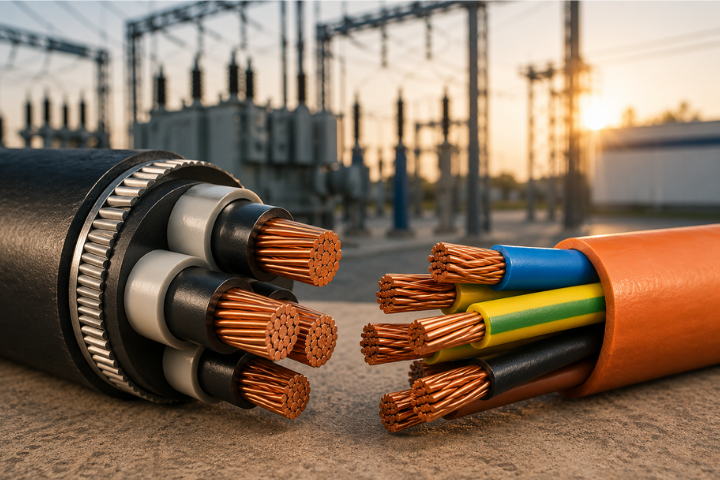
HT vs LT Cables: Understanding the Key Differences
The correct choice of cable is crucial for electrical power distribution. The most popular choices are High Tension (HT) and Low Tension (LT) cables. They are both used to deliver electricity, but they serve different functions depending on the voltage. Industry, commercial facilities, and infrastructure projects must make informed decisions based on an understanding of the difference between HT and LT cables.
What Are HT Cables?
HT cables are used to transmit electrical power at higher voltages, typically 1 kV or more, up to 33 kV or higher, depending on the application. These cables are generally employed in electrical power transmission systems, power substations, industrial power installations, and major infrastructure projects.
HT cables are insulated with thicker, more advanced insulation materials because higher voltages require protection against electrical leakage and breakdown. HT Cables, a reliable power transmission provider in the market, is chosen by many industries for supplying machinery manufacturing units and large commercial complexes in Gurugram.
What Are LT Cables?
The voltage up to 1kV uses LT cables. These cables are used throughout residential buildings, offices, shopping centres and small industrial units. They are vital in supplying electricity from transformers to end users.
LT cables have simpler insulation systems than do HT cables due to the lower voltage levels. With the surge in urban development and the growth of infrastructure projects, the demand for LT Cables in Gurugram remains robust.
Differences between HT and LT cables
1. Voltage Capacity
The primary difference is in the voltage capability. The cables used for higher-voltage transmission are called HT cables, and the cables used for lower-voltage distribution are called LT cables.
2. Insulation Design
HT cables need to be made with more durable insulation materials when dealing with higher electrical stress. Due to lower operating voltage, the insulation for LT cables is also comparatively light.
3. Applications
HT cables are also widely used in industrial plants, power stations, and the power grid. However, in Gurugram, LT Cables are widely used in residential, office, and commercial buildings.
4. Cost and Installation
In general, installing HT cable systems is more costly due to additional accessories, testing requirements, and safety precautions. LT cable installations are simpler and cost-effective.
5. Safety Requirements
HT Cables in Gurugram require special attention during installation and maintenance due to their high voltage. LT cable systems are easier to use but must be used within electrical safety limits.
Choosing the Right Cable
The decision to use HT or LT cables depends on the voltage, load capacity, installation setting and future expansion plans. Large-scale industrial use generally requires HT cables in Gurugram, whereas for commercial and residential projects, LT cables are beneficial. Knowing these distinctions helps to provide optimal power distribution and reliability.
Conclusion
The HT and LT cables are two of the integral parts of the present-day electrical network. HT cables are used for high-voltage transmission, and LT cables for safe and effective power distribution to end users. Electrotech Trading Company offers expert advice to businesses and industries on understanding different types of electrical cable requirements and applications to find quality solutions.